
Mirror Work History
The History of Mirror Work
Mirror work has appeared in different forms across several cultures, but the architectural tradition most closely associated with Abbey Atelier is the Persian art of Āyineh-kāri — literally, “mirror work.” In Iran, the technique developed during the Safavid period (1501–1736), when mirror glass began to be incorporated into palaces and architectural interiors. By the seventeenth century, European mirrors, particularly Venetian glass, were being imported into Persia and used as highly valued decorative materials. Contemporary travellers recorded mirrored surfaces in Safavid royal buildings, including the palaces of Shah Abbas I.
There is no single documented individual who can be identified as the inventor of Āyineh-kāri. Instead, it appears to have developed gradually through the work of Persian architects and craftsmen. Imported European mirror glass provided the material, while Iranian artisans transformed it into something distinctively Persian: mirrors were cut into smaller geometric and curvilinear pieces and incorporated into complex architectural compositions alongside plasterwork, muqarnas, painting and tile decoration. The technique therefore emerged through a meeting of imported glass technology and established Persian traditions of surface ornament and geometry.
Mirror work became considerably more elaborate during the Zand and especially the Qajar periods of the eighteenth and nineteenth centuries. Under the Qajars, entire walls, ceilings, columns, iwans and shrine interiors could be covered with thousands of precisely cut fragments. The many angled surfaces broke up and multiplied light, producing the brilliant, fragmented interiors now strongly associated with Persian mirror work. Important surviving examples can be found at Shah Cheragh in Shiraz, the shrine of Imam Reza in Mashhad, the shrine of Fatima Masumeh in Qom, and the Golestan Palace in Tehran.
Although Persian Āyineh-kāri has its own history, decorative mirror traditions also developed elsewhere. In the Indian subcontinent, mirrors became important within Mughal and later regional decorative traditions. Persian and Indian artistic cultures were closely connected during the Mughal period, with Iranian artists and craftsmen working alongside Indian makers at imperial courts. Separate traditions of shisha mirror embroidery also became especially important in Gujarat, Rajasthan, Sindh and neighbouring regions, where small pieces of reflective glass were incorporated into textiles.
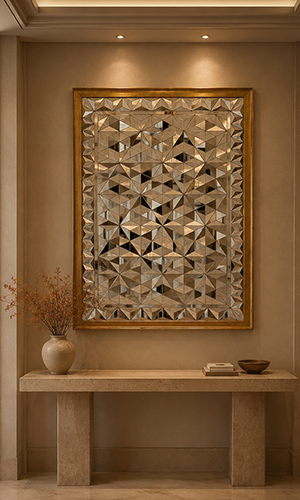
What distinguishes Persian architectural mirror work is the transformation of reflection into an entire surface. Rather than functioning as a single mirror intended simply to reproduce an image, hundreds or thousands of fragments divide and redirect what they reflect. Architecture, light and the viewer are broken into shifting images, making the surface appear to dissolve and change as one moves through the space.
This relationship between geometry, light and perception remains central to contemporary interpretations of mirror work. At Abbey Atelier, the historical language of Āyineh-kāri becomes a starting point rather than something simply reproduced, allowing an architectural tradition developed over centuries to be explored through contemporary artworks, sculptural surfaces and objects.